

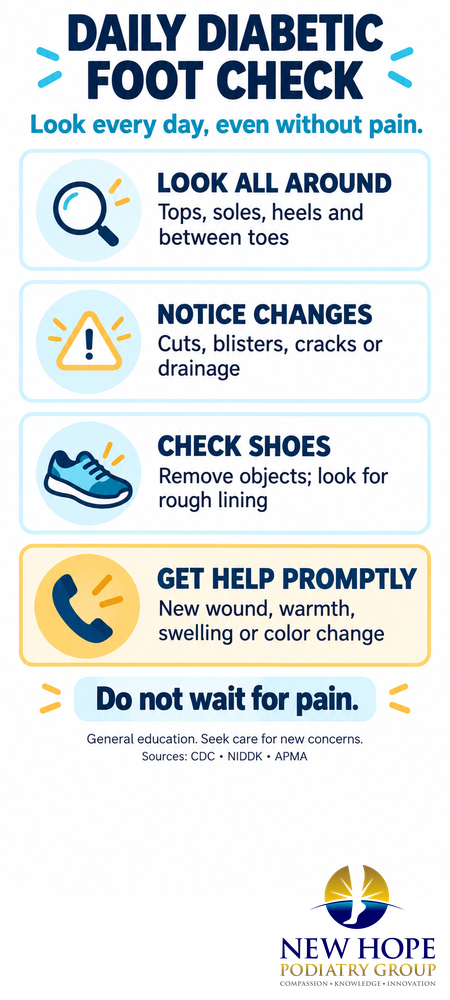
If you have diabetes, check both feet every day, including the soles and spaces between your toes. Look for changes in the skin, nails, shape, or swelling, even when nothing hurts. A new blister, open sore, or unusually warm, swollen foot needs prompt medical advice. Daily checks help you notice a problem; they do not replace a professional foot examination.
At New Hope Podiatry Group of Glendale, we evaluate foot and ankle concerns and help patients understand their next steps. A useful home routine begins with knowing what your feet normally look like and having a clear plan for reporting changes. You do not need to identify a diagnosis before asking for help.
Why feeling fine does not rule out a foot problem
Diabetes can affect the nerves that carry sensation from your feet. This is called peripheral neuropathy. It may cause burning, tingling, numbness, or reduced awareness of an injury. Some people have nerve damage without obvious symptoms. Being able to walk comfortably does not establish that the skin underneath your foot is intact.
Blood flow matters, too. Diabetes can be associated with reduced circulation, which can make wounds harder to heal. Pressure from a shoe or repeated rubbing can become more consequential when sensation and circulation are impaired. The purpose of checking is to spot a change before relying on pain to announce it.
These risks vary from person to person. Your clinician can assess your history and examination findings rather than assuming every person with diabetes has the same needs. Tell your care team about a previous ulcer, amputation, circulation problem, or loss of feeling, because that history helps guide monitoring.
Set up a routine you can actually repeat
Choose a regular moment, such as when you remove your shoes in the evening. Sit somewhere stable with good lighting. Keep a mirror within reach if it helps you see the bottoms of your feet. If balance, flexibility, or vision makes a complete inspection difficult, ask a trusted person to help rather than stretching into an unsafe position.
Use the same sequence each time so you are less likely to skip an area. For example, start with the left foot, move from the top to the sole, and finish between the toes before checking the right foot. There is no required speed or stopwatch target. A complete look is more useful than rushing through a checklist.
Keep your clinician’s contact information with your routine supplies. A paper checklist can have a space for the date and a short note about anything new. This is an organizational aid, not a home scoring system for deciding whether a wound is safe.
For an additional patient resource, the National Institute of Diabetes and Digestive and Kidney Diseases explains how diabetes affects foot health and daily care. Use your own clinician’s instructions when you have an existing wound or a prescribed care plan.
Inspect each surface rather than only the sore spot
Look at the top, sides, heel, and sole
Check for a cut, crack, blister, red area, or open sore. Look around the heel and under the ball of the foot, where problems can be easy to miss while standing. Use the mirror to see areas you cannot view directly. If you cannot tell whether a mark is new, describe the uncertainty when you call.
Pay attention to a new patch of thick skin or a change beneath a callus. Blood visible under a callus can signal a wound underneath. Do not cut into the area to investigate it. A clinician can examine the skin and decide what treatment is appropriate.
Check between the toes and around the nails
Look gently between each pair of toes for cracked skin, redness, peeling, or moisture-related changes. Check nail edges for irritation and notice nails that have become thick or discolored. Several conditions can change how skin and nails look, so appearance alone does not establish a fungal infection or another diagnosis.
This part of the inspection is an observation step. Avoid digging along a nail edge or using a sharp tool to explore a questionable area. If reaching your feet is difficult, arrange help with nail care rather than turning an inspection into a procedure.
Notice warmth, swelling, and shape changes
An unexplained change in temperature, swelling, or foot shape deserves attention. A foot that becomes unusually warm and swollen can reflect infection or another problem that needs assessment. In people with neuropathy, a condition called Charcot foot can damage bones and joints and may begin with warmth, redness, and swelling.
Do not use the absence of severe pain as a reason to continue normal activity on a newly hot, swollen foot. Seek prompt assessment and ask how to protect it while arranging care. You cannot distinguish Charcot changes from other causes through a photograph or a home checklist.
Check your socks and shoes as part of the same habit
Before putting footwear back on, look for blood or drainage on your socks. A stain may be the first clue to a skin break you did not feel. Note which foot and area it came from so you can describe it accurately. Do not simply change socks and ignore unexplained drainage.
Check inside each shoe for a pebble, rough lining, or another object. Notice whether a seam or edge lines up with a new irritated spot. Bring the shoes to an appointment if you think they are contributing to the problem; seeing the footwear can make that discussion more specific.
Choose shoes that fit without pinching or rubbing and wear suitable socks with them. New footwear still needs a gradual introduction and checks for irritation. A label such as diabetic or comfort does not tell you whether a particular shoe fits your foot. Ask about therapeutic footwear or inserts when ordinary shoes do not accommodate your needs.
Know when to call and when to seek emergency care
Contact your clinician promptly for a new blister, cut, ulcer, drainage, redness, or unexplained warmth or swelling. Tell the person answering that you have diabetes and describe the foot change. Do not wait for a scheduled routine visit or for pain to develop. If your usual clinician is unavailable, seek another appropriate medical service for advice and assessment.
New numbness, burning, altered temperature sensation, or a developing change in foot shape also warrants medical evaluation. Mention symptoms that interfere with sleep or walking. Reporting the timing and location is more helpful than deciding in advance that the symptoms must be caused by diabetes.
Seek emergency medical care for rapidly worsening redness or swelling, blackened skin, or a foot problem accompanied by fever or feeling seriously unwell. These findings can reflect a serious infection or another urgent complication. An office appointment request is not an emergency-care pathway.
The American Podiatric Medical Association describes why an open diabetic foot ulcer needs immediate podiatric care. An ulcer is an open wound, and it can be serious even when it is painless. Early evaluation does not mean that every wound will need the same treatment.
Protect the skin without trying to treat a wound yourself
For routine hygiene, wash your feet with warm rather than hot water and dry them carefully, including between the toes. Avoid soaking. Moisturizer can help dry skin on the tops and bottoms of the feet, but keep it out of the spaces between your toes. Ask your care team about products if your skin is cracked or you already have a wound.
Avoid walking barefoot, including inside your home. Protect your feet from hot surfaces and do not use a heating pad or hot-water bottle to warm them. Reduced sensation can make it harder to recognize damaging heat. If your feet are cold, discuss the problem rather than applying stronger heat.
Do not cut corns or calluses, use medicated corn-removal products, or pop a blister. Avoid hydrogen peroxide or a soaking routine for an ulcer unless your treating clinician has specifically directed your care. Wound treatment may involve dressings and pressure relief, but the appropriate approach depends on the wound and circulation.
If you find an open area, contact your clinician for instructions rather than trying a series of home remedies. Ask how to protect the area and how much weight you should put on that foot while awaiting assessment. Continue any existing prescribed wound plan unless your treating team advises a change.
Use professional exams to understand your personal risk
A home inspection cannot measure circulation or fully test protective sensation. A comprehensive clinical foot examination can assess the skin, nails, foot structure, pulses, and sensation. A clinician may use a monofilament, a thin nylon strand, to test whether you detect light pressure. Other tests may be appropriate depending on the findings.
People with diabetes generally need a comprehensive foot examination at least yearly, with more frequent assessment when risk factors or existing problems warrant it. Ask for a foot check during routine healthcare visits as well. Your care team should determine the schedule for your situation; daily checks do not replace those visits.
Our website lists diabetic foot and ankle care among the conditions we address and includes wound care among our podiatry services. An evaluation helps clarify the concern and whether other members of your diabetes care team need to be involved. We do not promise a particular result or treatment before examining you.
Make the first conversation with your clinician useful
When you call, explain what changed, which foot is involved, and when you first noticed it. Mention drainage, warmth, swelling, a color change, or feeling unwell. Also say whether you have an existing ulcer or prescribed wound-care plan. These details help the clinical team decide how to direct you; they do not replace an examination.
For a planned visit, bring your medication list and the footwear you wear most often. Write down questions about nail care, shoe fit, activity, and how to reach the team after hours. If another clinician manages a related problem, note that person’s name so coordination can be discussed through the practice’s normal process.
You can also ask the team to demonstrate how to inspect a hard-to-see area. Tell them if a mirror, bending, or reading small print is difficult. A useful care plan needs to fit what you can realistically do at home, including help you may need from someone else.
Frequently asked questions
1. Do I need daily checks if my diabetes was only recently diagnosed?
Yes. Daily inspection is useful even when you feel well or have only recently learned you have diabetes. Ask about an initial foot assessment rather than waiting for a symptom. The exam can help establish your current risk and a follow-up plan without assuming that you already have nerve damage.
2. What if I cannot bend down or see the bottoms of my feet?
Try a mirror while seated safely, or ask someone you trust to help with the inspection. Tell your clinician if vision or mobility makes the task unreliable. You can ask for a demonstration and discuss practical assistance instead of repeatedly missing the same areas.
3. Does tingling automatically mean diabetic neuropathy?
No. Tingling can occur with neuropathy, but a symptom by itself does not identify its cause. Describe when it happens, where you feel it, and any other changes to your clinician. Evaluation may involve your history, an examination, and additional testing rather than a conclusion based only on diabetes.
4. Can I trim my own toenails?
Some people can trim nails safely, but difficulty seeing, reaching, or feeling the feet changes that decision. Thick nails or nails curving into the skin also need professional advice. Ask your podiatrist what is appropriate for you; do not dig into the corners or cut irritated skin.
5. Will a photograph tell me whether a spot is safe?
A photograph may help you explain a change, but it cannot establish circulation, sensation, wound depth, or the full extent of an infection. Ask your clinician whether they have an approved way to receive images. Do not let taking or sending a photo delay care for warning signs.
6. Should I keep exercising if I find an open sore?
Do not try to walk through an open sore or choose your own pressure-relief device. Contact your care team promptly and ask which activities are safe while the foot is assessed. Exercise advice for intact skin does not automatically apply to a foot with a wound.
7. Do special socks replace properly fitted shoes?
No. Socks and shoes serve different purposes, and socks alone do not provide the protection of footwear. Ask about fit, seams, moisture, and any need for specialized footwear at your visit. A product marketed for diabetes does not replace an assessment or make pressure on the foot harmless.
8. If an old ulcer has healed, can I stop paying extra attention?
A previous ulcer remains relevant to your future care even after the skin closes. Tell your clinician about its location and history, and follow the recommended monitoring and footwear plan. Ask what changes should prompt a call and how frequently your feet should be examined.
Arrange foot care in Glendale
For a routine evaluation, call New Hope Podiatry at (818) 265-1581. Our Glendale office is at 1530 E. Chevy Chase Dr., Suite 107, Glendale, CA 91206. Our appointment page explains how to request a visit by phone. For urgent warning signs, seek appropriate medical care rather than waiting for a routine appointment.