
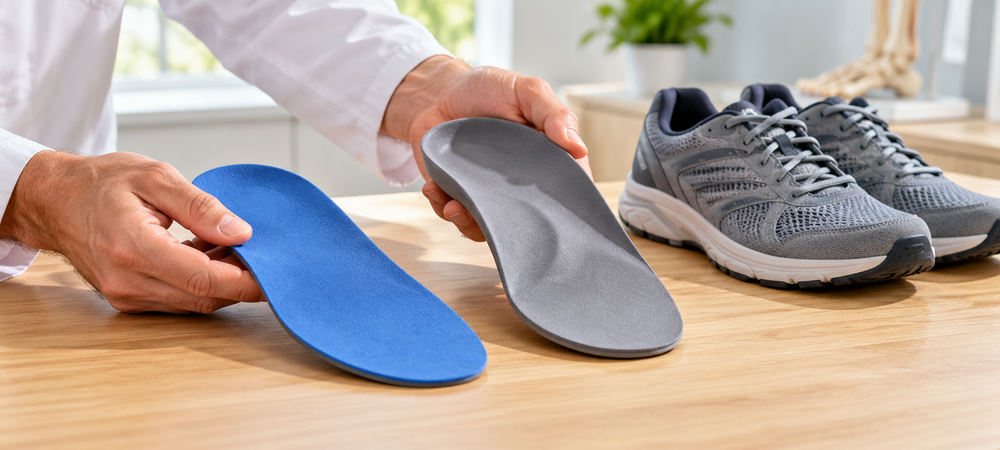
Shoe inserts and custom orthotics can look similar, but choosing between them starts with the reason your feet need support. A retail insert may be enough for extra cushioning; persistent pain or a complex foot problem calls for an evaluation before another purchase. At New Hope Podiatry Group of Glendale, we offer custom orthotics as part of our podiatry services. The goal is to choose support that fits the clinical problem and the shoes you actually wear, rather than assuming the most expensive or firmest option is best.
Understand the difference between inserts and custom orthotics
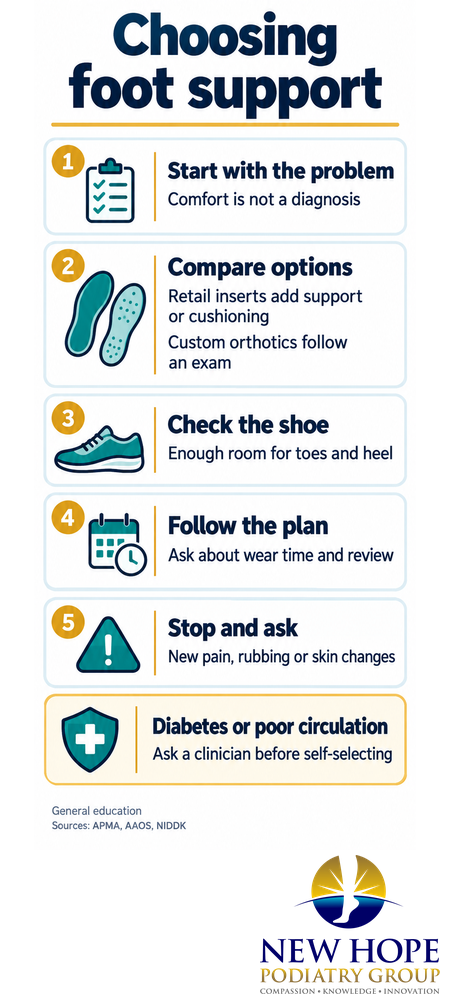
For this guide, a shoe insert means a ready-made support purchased without an individual prescription. Examples include cushioned insoles, arch supports and heel cups. A prescription custom orthotic is made for an individual after a clinical evaluation. The American Podiatric Medical Association explains this distinction in its patient guide to custom orthotics and shoe inserts.
Terminology varies. You may see the word orthotic used for both prefabricated and custom devices. Ask what a product actually is, who selects it and whether it is made from an individual prescription. A label such as personalized does not answer those questions by itself. The meaningful comparison is between the purpose, fit and clinical oversight of the options available to you.
Start with the problem rather than the product
Before shopping, put your main concern into a sentence. You might want more cushioning in otherwise comfortable walking shoes, or you might have heel pain that interrupts the first part of your day. Those are different problems. A purchase intended to improve comfort should not quietly become a substitute for investigating a symptom that keeps returning.
Write down where the discomfort occurs, when it started and which activities bring it on. Include recent changes such as a new job requiring standing or a different exercise routine. You do not need to identify the injured structure yourself. A clear description of what happens during ordinary activity is more useful than arriving with a diagnosis copied from a product advertisement.
If pain is persistent, worsening or limiting walking, arrange an examination. Our information about foot pain evaluation and treatment explains why the cause matters. Foot support is one possible part of care, not the answer to every source of pain. An injury, nerve problem or other condition may require a different approach.
Compare the treatment goal rather than assuming custom is better
An orthotic may be intended to support the foot, change how forces act during movement or accommodate an area that needs cushioning. The design depends on the problem being addressed. A softer device is not necessarily less appropriate, and a rigid device is not automatically more therapeutic.
AAOS notes that an over-the-counter device can work as well as a custom device in some situations, particularly as part of a broader exercise or stretching plan. That does not establish that every retail insert is equivalent to every prescription. It means that custom manufacture alone is not a reason to expect a better result for every person.
Ask the clinician to explain the proposed goal in ordinary terms. Is the support meant to reduce pressure in a particular area, support a painful foot or help manage a movement-related problem? What finding during the examination led to that recommendation? The answer should connect the device to your needs, rather than treating arch height or a brand name as the whole decision.
Check whether the shoe can accommodate the support
The device and the shoe have to work together. A well-selected support can still be difficult to wear in a shoe without enough room. NHS orthotics guidance emphasizes adequate depth and width, a secure fastening and footwear that can accommodate the device. Bring the shoes you expect to use, rather than judging an insert only while holding it in your hand.
Check the following with the fitter or prescribing clinician:
Does the heel sit securely inside the shoe rather than being lifted against the back edge? Is there room for the toes without squeezing or crowding? Does the support sit as intended instead of sliding or folding? Can you fasten the shoe comfortably with your usual socks? If a removable factory liner is present, ask whether it should come out; do not assume you should stack layers to make the shoe softer.
Discuss the practical limits of your footwear. A work boot, walking shoe and slim dress shoe may not accommodate the same device. If your job has a required shoe or safety standard, bring that information to the appointment. It is better to identify a compatibility problem before ordering than to receive a support you cannot use during the activity that matters most.
Know what an orthotic evaluation can clarify
An evaluation considers more than the outline of the sole. Your clinician may examine the feet and ankles, observe walking and assess movement in light of your symptoms and health history. If a custom device is appropriate, measurements or a model of the feet help guide its manufacture. The specific method depends on the clinical setting; no particular scanning system is necessary to understand the basic decision.
Ask what alternatives are reasonable. Depending on the diagnosis, care might include a prefabricated support, a change in footwear, an exercise program or another treatment. For plantar fasciitis, for example, AAOS describes both premade and custom supports among nonsurgical options, alongside other measures. An insert is not a complete treatment plan for every case of heel pain.
Custom orthotics are among our podiatry services, but we do not assume that every patient needs a custom device. We can evaluate your concern and discuss options appropriate to the findings. Bring existing supports, even if they were uncomfortable, so the conversation can address what you have already tried.
Use a wear and follow up plan you can understand
If support is recommended, ask for instructions before leaving. These should explain which shoes to use, how to introduce the device and what should prompt a call. Orthotics providers commonly advise gradual introduction, but a generic schedule may not suit your device or medical needs. Follow the instructions given for your individual prescription rather than borrowing someone else’s timetable.
Keep a short record of the activities you can perform and any new discomfort. For example, note which shoe you wore, how long you used the support and whether the original problem changed. This is a way to communicate observations, not a home test that proves the diagnosis or guarantees the device is working.
Ask when review is appropriate and whom to contact if fit is a problem. Do not cut, heat, bend or otherwise modify a prescribed device without guidance. NHS provider instructions caution against self-adjustment and advise seeking help for pain or skin problems. A follow-up conversation is more useful than continuing to wear something that creates a new problem because you expect it to break in eventually.
Recognize when to stop shopping and seek care
New pain, rubbing, blisters or skin changes deserve attention. Remove a device that is causing a problem and contact the clinician who supplied it for advice. Inspect the skin and the inside of the shoe rather than relying only on how the support feels. If you have an existing pressure-relief prescription or wound-care plan, ask your treating team what to use while the device is being assessed.
People with diabetes, poor circulation, reduced sensation or a history of foot wounds should get professional guidance before self-selecting support. Diabetes can reduce sensation and blood flow, so an area of harmful pressure may not produce an obvious pain signal. The NIDDK guidance on diabetes and foot problems explains why skin changes and footwear fit matter. A sore, redness or warmth should not be dismissed as ordinary adjustment.
A sudden injury with severe pain, marked swelling, an obvious deformity or inability to put weight on the foot needs prompt medical assessment, not a trial of insoles. Seek urgent care for a suspected serious injury. A foot that is becoming red, hot or swollen, particularly with a wound or diabetes, also needs prompt clinical advice. These concerns are separate from arranging a routine orthotic appointment.
Ask practical questions before paying for a device
Once the clinical purpose is clear, discuss the purchase itself. Ask whether the recommendation is for a retail product, a professionally fitted prefabricated support or an individually manufactured prescription. Request an explanation of what is included, such as fitting, adjustments and follow-up. Keep the written information so you can refer to it later.
If you are comparing options, ask each provider the same questions. What problem is the device intended to address? Which shoes can accommodate it? What happens if it does not fit comfortably? Who should assess a new symptom? What are the return, adjustment or replacement terms? These are useful consumer questions, not a promise that any particular policy is available.
For an appointment, bring your regular shoes, existing inserts, a medication list and relevant records. APMA recommends preparing a symptom and question list and bringing walking or exercise shoes when those activities are involved. Tell the office in advance about mobility or communication needs. You can also write down your most important activity goal, such as tolerating a work shift or returning to a comfortable neighborhood walk.
Frequently asked questions
Do painless flat feet mean I need custom orthotics
A low-looking arch alone does not select a device. Ask whether there is a symptom, functional problem or other examination finding that needs treatment. If you are comfortable and concerned only because a retail display labels your arch as flat, discuss that concern rather than assuming a purchase is required.
Does a retail foot scan count as an orthotic evaluation
A scan may provide measurements used to select a product, but it does not by itself establish the cause of pain. Ask whether a licensed clinician has evaluated you, what the scan measures and how the recommendation relates to your symptoms. Clarify whether the device is prefabricated or individually prescribed.
Should an arch support feel very firm to work
Firmness is not a universal measure of quality. Orthotic designs can emphasize support, cushioning or accommodation according to the clinical goal. Ask why a particular material is recommended for you. Do not interpret painful pressure as proof that a support is correcting your foot.
Are custom orthotics always necessary for plantar fasciitis
No. Premade supports and custom orthotics are both used in nonsurgical care, and other measures may be part of treatment. The choice depends on an assessment and response to care. Recurrent heel pain should be evaluated rather than repeatedly treated as plantar fasciitis solely because an insert is marketed for it.
Can I move one pair of supports between all my shoes
Only if the device is compatible with each shoe and its intended use. Check the fit with the clinician or fitter, particularly when switching between shoes with different depth or shape. If transferring it is impractical, ask about your options instead of forcing it into a tighter shoe.
How long should breaking in a prescription take
There is no single timetable appropriate for every reader. Follow your prescribing clinician’s wear instructions and ask when to report discomfort. New pain, rubbing or skin damage should lead to advice, not a decision to push through a predetermined number of days. High-risk feet need particular caution.
When should I replace old inserts or orthotics
Ask the supplier or clinician how to inspect your particular device and when review is due. Report cracks, sharp edges, loose components or a fit that has changed. Replacement should not be based only on an arbitrary anniversary, and returning symptoms may need reassessment rather than an identical new pair.
Will insurance cover custom orthotics
Do not assume coverage from a product description or another person’s experience. Ask your insurer about your plan’s benefits, documentation and authorization requirements, and confirm any expected charges with the office before proceeding. Request a written explanation when you are unsure what a proposed charge includes.
Arrange a foot support evaluation in Glendale
If recurring discomfort or difficulty fitting support is affecting your day, call our Glendale office at (818) 265-1581 to request an evaluation. We can discuss your symptoms and whether an orthotic assessment is appropriate. See our appointment information for the phone-based next step. Our office is at 1530 E. Chevy Chase Dr., Suite 107, Glendale, CA 91206. Bring the shoes and supports you use most often so the discussion reflects your daily needs.
This article provides general educational information and does not replace an evaluation, diagnosis, or treatment plan from a qualified healthcare professional.