
A rough spot on the bottom of your foot can look simple, but a plantar wart and a callus are not the same problem. A callus is thickened skin that develops in response to repeated pressure or friction. A plantar wart is a viral skin growth on the sole of the foot. Both can become uncomfortable under body weight, and either may be covered by a layer of hard skin. That overlap makes self-diagnosis less reliable than many online checklists suggest.
This guide explains the clues a podiatrist uses, why pain alone does not settle the question, and when it is safer to have the area examined before trying a remover. It is general education, not a diagnosis. A new, changing, bleeding, infected, or uncertain lesion deserves professional attention, especially if you have diabetes, reduced circulation, numbness, or a weakened immune system.
Why Plantar Warts and Calluses Are Easy to Confuse
The sole of the foot is built to tolerate pressure. When one small area repeatedly rubs against a shoe or carries more load than surrounding skin, the outer layer can thicken. That protective response may form a broad callus or a more concentrated corn. The thickened surface can feel rough, firm, and tender when you stand.
A plantar wart can also become firm and flat because walking pushes it inward. Hard skin may build over the growth, hiding the features people expect from a wart elsewhere on the body. A wart on a weight-bearing part of the heel or forefoot may therefore resemble a callus created by pressure.
The distinction matters because the causes and management differ. Pressure reduction is central to callus care. Wart care is directed at a viral growth, and treatments that damage tissue can injure normal skin if the diagnosis is wrong. Some less common skin lesions can also resemble either condition, so persistent uncertainty is a reason for evaluation rather than more aggressive self-treatment.
What Is a Plantar Wart
A plantar wart, also called a plantar verruca, is a growth caused by certain types of human papillomavirus. The virus can enter through tiny breaks in the skin. Warts may occur as one lesion or as a cluster, sometimes called mosaic warts. They can spread to nearby skin or to another person through direct contact or contaminated surfaces, although exposure does not mean everyone will develop a wart.
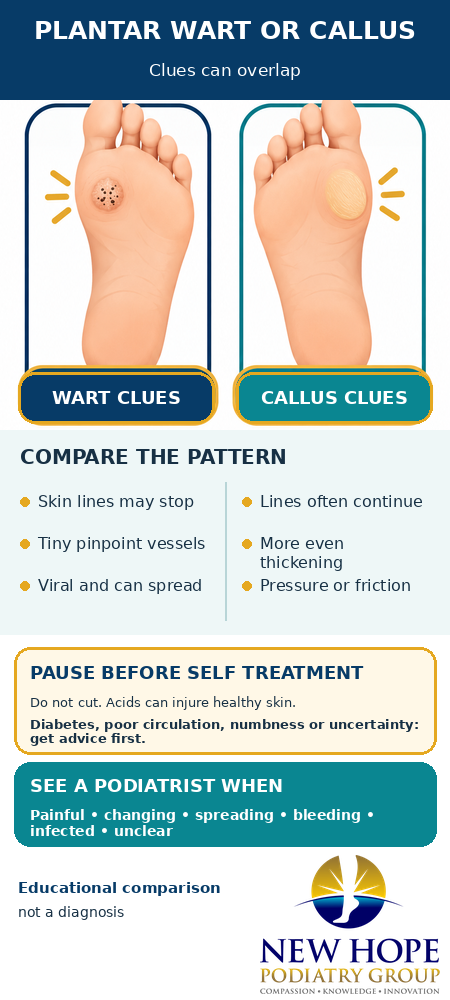
Typical clues include a grainy or irregular surface, interruption of the normal skin lines, and tiny dark or red pinpoint dots within the lesion. Those dots are small blood vessels, not roots or seeds. A layer of callused skin may cover them, which is one reason an examination can be more informative than looking at the surface at home.
Plantar warts can be painless, mildly tender, or quite uncomfortable. A lesion under the heel or ball of the foot may feel as if you are stepping on a pebble. The American Podiatric Medical Association overview of plantar warts notes that they are often mistaken for corns or calluses and may be resistant to treatment or recur.
What Is a Callus
A callus is an area of thickened skin formed in response to repeated friction or pressure. It is not an infection and is not contagious. Calluses commonly appear under the heel, ball of the foot, or another spot that repeatedly bears load. They may be broad and flat, and the normal skin lines often continue across them.
Calluses may develop because of shoe fit, walking mechanics, activity, a prominent bone, or a toe or foot shape that concentrates pressure. The thickened skin itself may be painless. It can become tender when it grows deep, cracks, or sits over a high-pressure point. Treating only the surface does not necessarily address the pressure that caused it.
The American Podiatric Medical Association guidance on corns and calluses explains that mild lesions may not need treatment, while painful or activity-limiting areas warrant evaluation. It also cautions that over-the-counter chemical products can harm skin, particularly for people with diabetes.
Plantar Wart Versus Callus Clues
No single home test is perfect. A podiatrist considers several features together and the overall clinical context.
Cause and pattern
A callus usually sits where pressure or rubbing is repeated. You may see similar thickened areas on both feet if the same shoes or movement pattern affect each side. A wart can also occur at a pressure point, but its location is determined by where the virus entered the skin rather than by pressure alone.
Skin lines
Natural lines generally continue through a callus. A wart often disrupts or bends those lines around the lesion. This is a helpful clue, not a guarantee. Thick overlying skin, picking, filing, or prior treatment can make the pattern difficult to see.
Surface and pinpoint dots
A callus tends to look more evenly thickened. A wart may have a rougher, more irregular surface with tiny pinpoint dots. Not every wart displays obvious dots, and dark specks can have other causes. Avoid digging, scraping, or cutting into the area just to look for them.
Tenderness
People sometimes hear that a callus hurts with direct downward pressure while a wart hurts when squeezed from the sides. That pattern can occur, but it is not reliable enough to make a diagnosis by itself. Both lesions can hurt under direct load, and pain is influenced by thickness, location, inflammation, and nearby structures.
Contagiousness
A callus cannot spread from one person to another. A wart can spread because it is viral. Repeated touching, picking, or using the same file on affected and unaffected skin may move viral material. Do not share foot files, pumice stones, nail tools, socks, or shoes when a wart is suspected.
Why Cutting or Using Acid Without a Diagnosis Can Be Risky
Trying to slice away a thick spot at home can cause bleeding, infection, and a wound in an area that must bear weight. It also does not correct the pressure behind a callus or reliably remove a wart. Bathroom tools are not the same as sterile clinical instruments, and judging how deeply to cut is difficult.
Wart and corn removers often contain acids that destroy skin. Even when a product is appropriate for a correctly identified lesion, it can irritate or burn surrounding tissue. It should not be placed on broken, inflamed, infected, or uncertain skin. Following the product label does not replace confirming what the lesion is.
Avoid self-treatment and arrange an examination first if you have diabetes, poor circulation, peripheral neuropathy, reduced sensation, immune suppression, a history of foot ulcers, or difficulty seeing or reaching the area safely. These factors can make an injury harder to notice or heal and can raise the consequences of a small wound.
When to Have the Spot Examined
An office visit is appropriate when the diagnosis is uncertain, the area is painful, the lesion is spreading, or repeated home care has not helped. Seek evaluation promptly if you notice drainage, warmth, expanding redness, swelling, a foul odor, fever, a deep crack, or an open sore. A rapidly changing color, irregular pigment, unexplained bleeding, or a growth that looks different from your other skin lesions also deserves assessment.
People with diabetes, circulation problems, numbness, or immune suppression should use a lower threshold for professional care. Do not wait for pain to become severe if you may not feel the area normally.
If you are otherwise healthy and the spot is small, stable, and not bothersome, monitoring it may be reasonable. Keep it clean, avoid picking, and reduce obvious rubbing while you arrange care if it changes. Do not assume that a painless lesion is harmless or that every rough area is a wart.
What a Podiatric Evaluation May Include
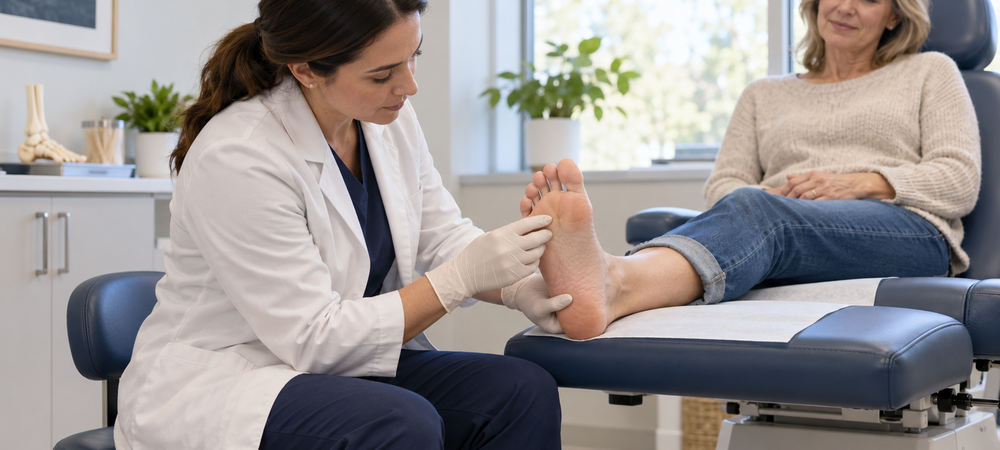
The visit begins with history and inspection. Your podiatrist may ask when the area appeared, whether it has changed or multiplied, what makes it hurt, what shoes and activities affect it, and whether you have had similar lesions. Medical conditions, circulation, sensation, medications, and prior treatments can change the safest plan.
The clinician examines the surface, border, skin-line pattern, nearby callus, and location relative to pressure points. Magnification or dermoscopy may help reveal vascular patterns that are not obvious to the naked eye. In selected cases, carefully reducing the overlying dead skin can make the underlying pattern easier to assess. This should be done by a trained professional rather than attempted with a blade at home.
Most plantar warts and calluses are diagnosed clinically. If a lesion is atypical, changing, pigmented, ulcerated, or unresponsive to reasonable treatment, a biopsy or referral may be considered to rule out another condition. That does not mean a serious diagnosis is expected; it is a way to resolve uncertainty safely.
How Treatment Differs
Callus management
Callus care focuses on reducing excess pressure or friction. Depending on the cause, this may include footwear changes, padding, activity adjustments, or support that redistributes load. A podiatrist can safely reduce thickened dead skin when appropriate and look for a structural or movement-related reason the callus keeps returning.
Recurrence is common if the pressure source remains. A callus should not simply be treated as unwanted skin when it marks a recurring load point. For someone with diabetes or reduced sensation, that spot may also signal an area at risk for skin breakdown and deserves closer monitoring.
Plantar wart management
Some plantar warts resolve without treatment, while others persist, spread, or become painful. Management depends on the number, location, duration, symptoms, previous treatment, and the person’s health. Options may include clinician-directed topical therapy, cryotherapy, or other office treatments. No method works for every wart, and more than one session may be needed.
The goal is to treat the wart while limiting injury to healthy skin and preserving comfortable function. A treatment plan should account for healing capacity and the pressure placed on the area during daily activity. Recurrence can happen even after the lesion appears to clear, so follow-up may be useful if the spot returns.
Practical Steps While You Are Waiting for an Appointment
Do not pick, cut, or shave the lesion. Keep the foot clean and dry, and use clean socks. If friction is aggravating the area, choose roomier footwear and avoid a pad that places direct pressure on the painful center. Do not share foot-care tools, and do not use the same file or pumice stone on the suspected lesion and healthy skin.
If a wart is possible, wear sandals in communal showers and pool areas and avoid walking barefoot there. Covering a lesion may reduce direct contact with shared surfaces, but do not seal wet or irritated skin under an occlusive dressing for long periods without guidance.
Take a clear photograph with the date if you are monitoring change. Note whether the area is enlarging, multiplying, bleeding, draining, or becoming more painful. This information can help during an evaluation, but it should not delay care when warning signs are present.
Preventing Recurrence and Protecting the Skin
For pressure-related calluses, wear shoes that fit the length, width, and shape of your feet. Replace footwear that is worn unevenly, and address repeated rubbing rather than repeatedly filing the resulting skin. If the same callus returns, an assessment of foot mechanics, toe position, or shoe pressure may be more useful than another surface treatment.
For warts, avoid picking and maintain basic foot hygiene. Wear footwear in communal wet areas, allow shoes to dry, and keep personal foot-care tools separate. Because warts can recur, check the surrounding skin after treatment and arrange follow-up if new lesions appear.
Healthy skin is the priority in both situations. Aggressive removal is not prevention. A correct diagnosis and a plan aimed at the underlying cause offer a safer path than repeated cutting or chemical treatment.
Frequently Asked Questions
Can a plantar wart look like a callus
Yes. Body weight can flatten a wart, and hard skin may grow over it. The surface can then resemble a callus. Skin-line changes, pinpoint vessels, lesion borders, and the pressure pattern help with diagnosis, but an examination is the most reliable way to resolve uncertainty.
Do black dots always mean a plantar wart
No. Pinpoint dark dots can represent small blood vessels within a wart, but color alone is not diagnostic. Dried blood, debris, or another skin lesion can look similar. Do not cut into the spot to search for dots.
Is a callus contagious
No. A callus forms in response to friction or pressure and does not spread between people. A plantar wart is caused by a virus and can spread through contact, which is why shared foot-care tools should be avoided.
Can I use a wart remover if I am not sure what the spot is
It is safer to confirm the diagnosis first. Acid-based products can injure healthy skin and may be inappropriate on broken, inflamed, or infected areas. People with diabetes, circulation problems, numbness, immune suppression, or a history of ulcers should avoid self-treatment unless a qualified clinician specifically directs it.
Should I file down a painful callus
Do not cut or aggressively file a painful or uncertain lesion. Even a true callus can hide irritated or damaged skin underneath. A podiatrist can reduce thickened skin safely when appropriate and identify the pressure source that may be causing it to return.
Will a plantar wart go away on its own
Some warts clear as the immune system responds, but the timing is unpredictable. A wart that is painful, spreading, persistent, bleeding, or difficult to identify should be evaluated. Health conditions that affect healing are another reason not to wait or experiment with treatment.
When is a rough spot on the foot urgent
Seek prompt medical attention for an open sore, spreading redness, warmth, swelling, drainage, foul odor, fever, rapidly changing color, unexplained bleeding, or severe pain. People with diabetes, reduced circulation, or numbness should seek care earlier because a significant injury may not feel painful.
What can a podiatrist do that I cannot do at home
A podiatrist can evaluate the lesion in the context of your skin, circulation, sensation, footwear, and pressure pattern. The clinician may use magnification, safely reduce overlying dead skin, select treatment that fits the diagnosis, and investigate an atypical or persistent growth instead of assuming it is a wart or callus.
Schedule an Evaluation in Glendale
If a rough or painful spot on your foot is difficult to identify, New Hope Podiatry Group of Glendale can evaluate the area and discuss options based on the diagnosis and your health. Review the practice’s conditions treated or call the Glendale office at (818) 265-1581. The appointment page explains how to request a visit by phone.
This article provides general educational information and does not replace an evaluation, diagnosis, or treatment plan from a qualified healthcare professional.