
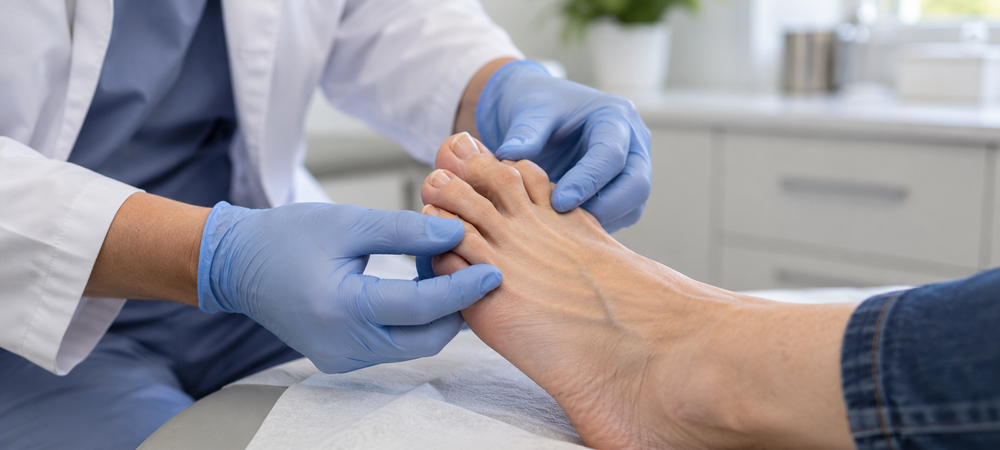
A toe that stays bent, rubs against the top of a shoe, or develops a recurring corn may have a hammertoe deformity. Early on, the joint may still move when you gently reposition the toe. Over time, the tendons and joint can become tighter, making the toe less flexible and more difficult to accommodate in footwear.
The difference between a flexible and rigid hammertoe matters because it can influence which treatments are reasonable. Roomier shoes and pressure-relieving measures may reduce irritation, particularly while a toe remains flexible, but they do not reliably correct every deformity. A painful, worsening, or fixed toe should be evaluated so the diagnosis, contributing mechanics, and treatment options can be matched to the individual.
New Hope Podiatry Group of Glendale evaluates foot and ankle concerns at its Glendale office. This article explains common hammertoe patterns, what you can safely observe, and when a podiatric examination may be appropriate.
What Is a Hammertoe?
A hammertoe is a bending deformity that most often affects one of the four smaller toes. The middle joint of the toe, called the proximal interphalangeal joint, bends downward while other parts of the toe may shift out of normal alignment. From the side, the raised joint can resemble the top of a hammer.
The American Podiatric Medical Association’s hammertoe overview distinguishes flexible hammertoes, which remain movable at the joint, from rigid hammertoes, which have become stiff and less reducible. The position of the toe is only part of the assessment. A podiatrist also considers pain, skin irritation, joint stability, foot mechanics, footwear, health conditions, and how the deformity affects walking.
“Hammertoe” is sometimes used broadly for several lesser-toe deformities. A mallet toe primarily bends at the joint closest to the toenail. A claw toe may involve upward positioning where the toe meets the foot and downward bending at more than one toe joint. Crossover-toe deformity can occur when instability causes a toe to drift toward or over a neighboring toe. These conditions can resemble one another, so an examination is more reliable than choosing a diagnosis from appearance alone.
Flexible and Rigid Hammertoes Are Different Stages of Mobility
The practical distinction between flexible and rigid is whether the involved joint can still be repositioned and how easily it moves. A toe can fall somewhere between the two descriptions rather than fitting neatly into one category.
A Flexible Hammertoe Can Still Be Moved
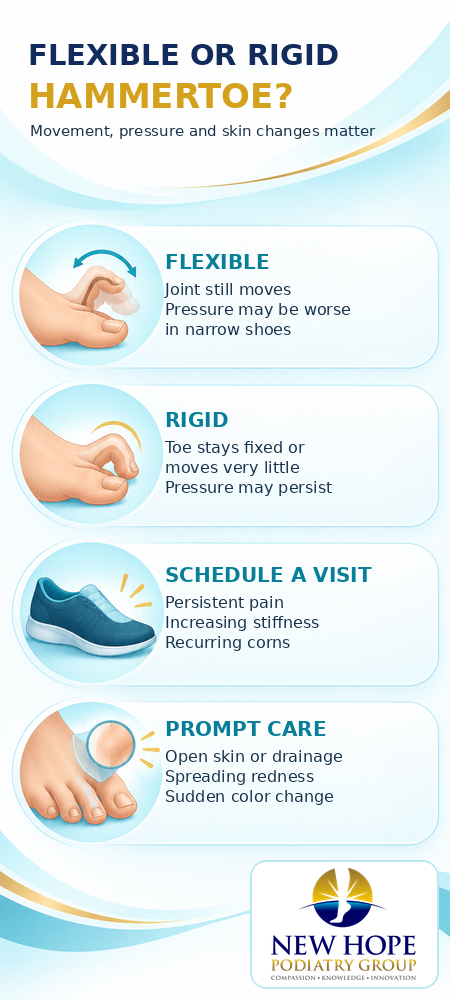
A flexible hammertoe may straighten partially when the foot is not bearing weight or when the toe is gently guided into a more neutral position. Symptoms may be intermittent and especially noticeable in narrow shoes, high heels, or footwear with a shallow toe box.
Because the joint still moves, pressure reduction and treatment of contributing mechanics may be more useful at this stage. A flexible toe can still cause significant pain, however. Flexibility does not mean the condition is harmless or that it will correct itself.
A Rigid Hammertoe Stays Fixed or Moves Very Little
A rigid hammertoe cannot be fully straightened with gentle movement. Tendons and soft tissues around the joint may have tightened, and the joint may have developed structural changes. The raised area can rub against footwear, while the tip of the toe or the area beneath the forefoot may carry added pressure.
Rigid does not automatically mean that surgery is required. Treatment depends on the amount of pain, skin breakdown, activity limitations, health risks, and response to appropriate nonsurgical measures. Still, a fixed deformity can be harder to accommodate, and surgical correction may be discussed when persistent symptoms interfere with daily life.
Do not repeatedly force a stiff toe straight. Forceful manipulation can irritate the joint or skin and will not determine the safest treatment.
Symptoms Often Come From Pressure and Altered Load
Some hammertoes are noticeable but do not cause meaningful discomfort. Others become painful when the toe presses against a shoe or when the deformity shifts pressure to the ball or tip of the foot.
Common concerns include:
- Pain or tenderness over the raised middle joint
- Redness, swelling, or irritation where the toe contacts footwear
- A corn on top of the bent joint
- Thickened skin or a callus at the toe tip or under the ball of the foot
- Painful or restricted toe movement
- A burning or aching sensation in shoes
- Difficulty finding shoes with enough depth
- A toe that gradually becomes more bent or overlaps another toe
- Pain beneath the base of the affected toe
- A blister, open sore, or drainage where pressure is concentrated
Symptoms such as numbness, color change, marked swelling, warmth, or an open wound need particular attention. They may reflect more than routine shoe irritation, especially in someone with diabetes, poor circulation, neuropathy, immune suppression, or a history of slow wound healing.
Why Hammertoes Develop
Hammertoes usually reflect an imbalance among the muscles, tendons, ligaments, and joints that position the toe. When the forces pulling across the toe are no longer balanced, the joint can gradually remain bent.
Possible contributors include:
- Shoes that squeeze the toes or place repeated pressure on a raised joint
- A long second toe or other inherited foot shape
- Bunions and changes in forefoot alignment
- Flat feet, high arches, or other mechanical patterns
- Prior toe injury
- Arthritis or joint inflammation
- Tendon or ligament imbalance
- Instability where the toe joins the foot
- Certain neuromuscular or neurologic conditions
Tight shoes can aggravate pressure and may contribute to progression, but footwear is not the only cause. A person can develop a hammertoe despite wearing sensible shoes if the underlying structure or muscle balance predisposes the toe to deformity.
A change in one toe can also affect neighboring areas. If the toe does not share pressure normally, the ball of the foot or adjacent toes may become sore. This is one reason treatment should consider the entire foot rather than only the raised joint.
What You Can Safely Try for a Mild Hammertoe
Self-care is most appropriate when symptoms are mild, the skin is intact, and there are no circulation or sensation concerns. These measures may reduce pressure and discomfort, but they should not be presented as a cure or a substitute for evaluation when the deformity is worsening.
Choose Footwear With Enough Toe Space
Look for a deep, rounded toe box that lets the toes rest without rubbing the top or sides of the shoe. The shoe should be long enough for the longest toe, secure through the heel and midfoot, and wide enough across the forefoot.
Avoid relying on a larger shoe size alone. A shoe that is too long may let the foot slide forward and increase toe pressure. The shape and depth of the toe box matter as much as the stated size.
Use Non-Medicated Padding Carefully
A non-medicated pad or sleeve may cushion a pressure point, provided it does not make the shoe tighter. Check the skin after wearing it. Stop if the device causes increased rubbing, discoloration, numbness, or swelling.
Avoid medicated corn-removal products unless a qualified clinician has said they are appropriate. These products can damage healthy skin and may be particularly hazardous for people with diabetes, neuropathy, or reduced circulation. Do not cut a corn or callus with a blade.
Adjust Activities That Repeatedly Aggravate the Toe
If a particular shoe, walk, exercise, or work task predictably increases irritation, a temporary change may allow inflamed skin and soft tissues to settle. The goal is not necessarily to stop all movement. It is to reduce repeated pressure while you determine why the toe is painful.
A wrapped cold pack may help short-term soreness or swelling for some people. Keep a cloth between the cold source and the skin, limit exposure, and avoid cold therapy when sensation or circulation is impaired unless a clinician has advised it.
Be Cautious With Splints and Exercises
Toe spacers, straps, and splints can sometimes improve comfort or temporarily hold a flexible toe in a more favorable position. They may not fit every deformity and should not be tightened enough to impair circulation or damage the skin.
Exercises may help maintain available motion in selected flexible deformities, but they cannot be assumed to reverse structural joint changes. Stop if movement causes sharp pain, skin injury, or worsening symptoms.
When to Schedule a Podiatry Evaluation
A hammertoe does not need to become rigid before it deserves attention. Earlier evaluation can clarify whether the toe remains flexible, identify the main pressure points, and determine whether another condition is contributing.
Schedule an appointment when:
- Pain persists despite roomier shoes and basic pressure relief
- The toe is becoming more bent, stiff, or difficult to move
- Corns or calluses repeatedly return
- The deformity interferes with walking, exercise, work, or shoe wear
- The toe begins crossing over or pressing against another toe
- Pain develops beneath the ball of the foot
- You are unsure whether the problem is a hammertoe, mallet toe, claw toe, arthritis, or another condition
- A brace, pad, or shoe insert creates new pressure
- The affected area repeatedly becomes red or swollen
People with diabetes, neuropathy, circulation problems, or a history of foot ulcers should use a lower threshold for evaluation. Reduced sensation can hide injury, and a small pressure point can become more serious before it feels painful.
Skin Breakdown or Circulation Changes May Need Prompt Care
Contact an appropriate healthcare professional promptly for a blister, open sore, drainage, spreading redness, increasing warmth, or a darkening area over a pressure point. Fever or feeling systemically ill with a foot wound requires urgent medical attention.
Seek urgent or emergency evaluation for a cold, pale, blue, or suddenly numb foot; rapidly spreading infection; uncontrolled bleeding; severe injury; or another sign that circulation or limb health may be threatened. Routine appointment forms should not be used to send private medical details or manage an emergency.
What a Podiatrist Checks
A hammertoe evaluation begins with the history of the deformity and symptoms. The podiatrist may ask when the toe changed position, whether it can still be moved, which shoes cause pressure, whether there was an injury, and how the problem affects walking or activity.
The examination may assess:
- Which toe joints are involved
- Whether the deformity is flexible, partly reducible, or rigid
- Tenderness, swelling, corns, calluses, blisters, or wounds
- Joint motion and stability
- Position of the toe where it joins the foot
- Bunions or other alignment changes
- Strength, sensation, circulation, and gait
- Wear patterns inside commonly used shoes
Weight-bearing X-rays may be useful when the result would affect treatment. They can show alignment, joint position, arthritis, or other bone findings, but imaging is not the only part of diagnosis. The physical examination helps show how the toe behaves under pressure and whether nearby structures are involved.
Treatment Depends on Symptoms, Flexibility, and the Whole Foot
The goal is to reduce pain and pressure, protect the skin, improve function, and address contributing mechanics where possible. The right plan differs for a mild flexible hammertoe and a painful fixed deformity.
Nonsurgical Care May Reduce Irritation
Depending on the examination, nonsurgical options may include:
- Footwear with additional toe-box width and depth
- Non-medicated padding or protective sleeves
- Taping or splinting for selected flexible toes
- Callus or corn care performed safely
- Activity modification
- Condition-specific stretching or strengthening
- Orthotic support when foot mechanics or forefoot pressure contributes to symptoms
- Medication or an injection when medically appropriate for a specific source of pain or inflammation
Custom orthotics do not directly straighten every hammertoe. They may be considered when redistributing pressure or addressing foot mechanics would help. New Hope Podiatry’s foot pain treatment information explains why treatment starts with identifying the structure and factors responsible for symptoms.
Surgery May Be Considered for Persistent Painful Deformity
Surgical treatment may be discussed when pain, skin pressure, shoe intolerance, or loss of function continues despite appropriate nonsurgical care. The procedure depends on the joints and soft tissues involved, whether the toe is flexible or rigid, and whether there is instability at the base of the toe.
Possible approaches can involve releasing or balancing a tendon, removing a small portion of bone, realigning a joint, or fusing a joint so it heals in a corrected position. These are general categories, not recommendations for an individual reader. Recovery, activity restrictions, swelling, fixation methods, and risks vary by procedure and patient health.
The decision should include the expected benefit, alternatives, recovery responsibilities, possible complications, and how other deformities may affect the result. Cosmetic appearance alone should not substitute for a discussion of symptoms and function.
How to Prepare for Your Visit
Bring the shoes you wear most often, including the pair that causes the most irritation. A podiatrist can learn from toe-box shape, pressure marks, and wear patterns that may not be obvious from a verbal description.
Also bring:
- A medication list and relevant medical history
- Information about diabetes, nerve symptoms, circulation problems, or prior ulcers
- A short timeline of when the toe changed and when pain began
- Photos if redness or swelling varies during the day
- A list of pads, inserts, braces, or home treatments already tried
- Prior foot imaging if available
Useful questions include: Is the toe flexible or rigid? Is the pain coming from the toe joint, a corn, the ball of the foot, or another structure? Would footwear changes, padding, or orthotics address the main pressure? What signs would mean I should return sooner? If surgery is discussed, what procedure is being proposed and why?
Hammertoe Care at New Hope Podiatry Group of Glendale
New Hope Podiatry Group of Glendale evaluates hammertoes and other causes of toe and forefoot pain. The visit can help determine whether the deformity remains flexible, identify pressure-related skin changes, and explain which conservative or surgical options may be appropriate. You can also review the broader conditions New Hope Podiatry treats.
To schedule an evaluation of a bent or painful toe, call the Glendale office at (818) 265-1581 or review how to request an appointment. Do not send private medical information through a general contact form.
Frequently Asked Questions
1. Can a Flexible Hammertoe Become Rigid?
Yes, a hammertoe may become less movable as the tendons and soft tissues tighten and joint changes develop. The pace varies, and not every flexible hammertoe progresses in the same way. Increasing stiffness, recurring corns, or worsening shoe pressure are reasonable reasons to schedule an evaluation.
2. Can I Test Whether My Hammertoe Is Flexible at Home?
You can observe whether the toe changes position when the foot is relaxed, but do not force it straight. A podiatrist can evaluate movement safely and determine which joints and soft tissues are involved. Home observation cannot rule out joint instability, arthritis, or another toe deformity.
3. Will Wider Shoes Fix a Hammertoe?
A wider and deeper toe box can reduce rubbing and pressure, particularly for a mild flexible deformity. Footwear generally does not reverse a fixed structural change. Continued pain or progression despite appropriate shoes should be evaluated.
4. Are Hammertoe Pads Safe?
A non-medicated pad may reduce friction if it fits without crowding the shoe. Check the skin regularly and stop if it causes pressure, numbness, swelling, or discoloration. People with diabetes, neuropathy, poor circulation, or fragile skin should ask a healthcare professional before using a pad.
5. Is a Corn on Top of the Toe the Same as a Hammertoe?
No. A corn is thickened skin caused by repeated pressure or friction. A raised hammertoe joint may create the pressure that produces a corn, but other shoe-fit and toe-position problems can do the same. Treating only the corn may not address the underlying pressure.
6. Do Orthotics Straighten Hammertoes?
Orthotics are not expected to straighten every hammertoe, especially a rigid one. They may help selected patients by redistributing pressure or addressing mechanics that contribute to symptoms. Their usefulness depends on the examination and the source of pain.
7. Does a Rigid Hammertoe Always Require Surgery?
No. Some rigid hammertoes can be managed with shoe accommodation, padding, and other conservative measures when symptoms are limited and the skin is healthy. Surgery may be considered when persistent pain, skin problems, shoe intolerance, or impaired function remains despite appropriate nonsurgical care.
8. When Is a Hammertoe Urgent?
A stable bent toe is not usually an emergency. Prompt evaluation is appropriate for an open sore, drainage, spreading redness, increasing warmth, darkened skin, or rapidly worsening swelling. A cold, pale, blue, or suddenly numb foot, systemic illness with a foot wound, or signs of severe infection require urgent or emergency care.
Disclaimer
This article provides general educational information and does not replace an evaluation, diagnosis, or treatment plan from a qualified healthcare professional.