

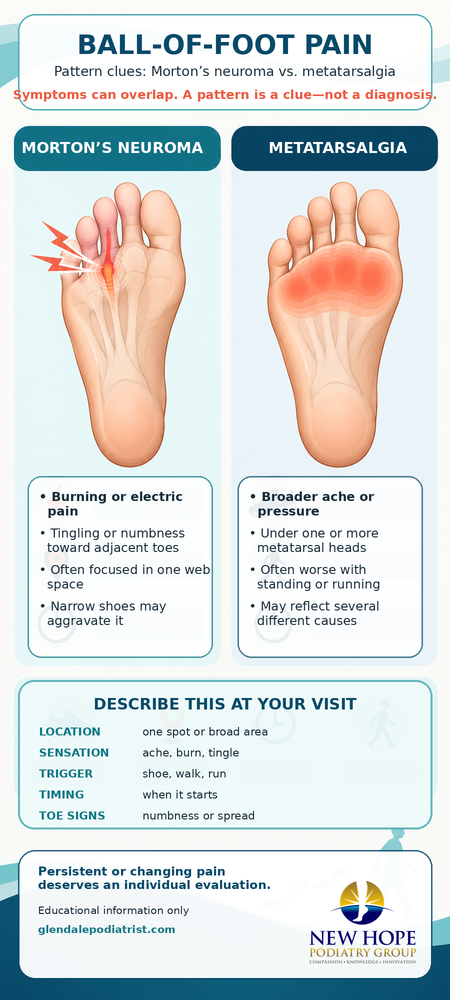
Pain beneath or just behind the toes is often described as metatarsalgia, Morton’s neuroma, or simply ball-of-foot pain. Those labels overlap, but they do not mean the same thing. Metatarsalgia describes pain in a region of the forefoot and can have several causes. Morton’s neuroma is a specific nerve-related condition that can produce pain in the same area.
The pattern of symptoms can provide useful clues. A broad ache or pressure under one or more metatarsal heads may feel different from burning or electric pain that travels toward neighboring toes. Even so, location and sensation alone cannot confirm the cause. Joint instability, a stress injury, arthritis, a callus, changes in the forefoot fat pad, or another nerve problem can resemble either pattern.
A podiatric evaluation can map the painful area, assess how the foot moves, examine the toes and joints, and decide whether imaging would change the treatment plan. The goal is not merely to name the symptom. It is to identify the structure being overloaded or irritated so care can be matched to the actual problem.
What Morton’s Neuroma and Metatarsalgia Mean
Understanding the terminology makes the comparison clearer. One term identifies a particular nerve condition. The other identifies a painful region that may have several possible explanations.
Morton’s neuroma involves an interdigital nerve
Morton’s neuroma is not a cancerous tumor. It generally refers to irritation and thickening, including fibrous tissue changes, around one of the interdigital nerves that runs between the metatarsal bones toward the toes. It most commonly involves the space between the third and fourth toes, although another web space can be affected.
The irritated nerve may cause burning, tingling, numbness, or a sharp sensation that travels into adjacent toes. Some people describe a feeling similar to a pebble, fold in a sock, or small object under the forefoot even when nothing is inside the shoe.
The American Podiatric Medical Association overview of neuromas describes common symptoms and factors that can place pressure on the nerve. These patterns are helpful, but no single symptom proves that a neuroma is present.
Metatarsalgia describes pain in the ball of the foot
Metatarsalgia is a descriptive term for pain around the metatarsal heads, the rounded ends of the long forefoot bones just behind the toes. It does not identify one uniform disease.
A person with metatarsalgia may have pain from repetitive loading, altered foot mechanics, a toe deformity, joint inflammation, a plantar-plate problem, a stress injury, a callus, reduced cushioning, or Morton’s neuroma. More than one factor can be present at the same time.
The pain may be concentrated beneath one metatarsal head or spread across a broader portion of the forefoot. It may feel achy, bruised, burning, or tender under pressure. Because the term is broad, a treatment aimed only at “metatarsalgia” may miss the underlying structure responsible for the pain.
How the Symptom Patterns May Differ
Morton’s neuroma and other causes of metatarsalgia can overlap enough that self-diagnosis is unreliable. Still, the location, quality, triggers, and associated toe symptoms can help organize the history for an evaluation.
Location
Morton’s neuroma commonly produces symptoms in a web space between the metatarsal bones, often between the third and fourth toes. Discomfort may begin in the ball of the foot and travel toward the adjacent toes.
Metatarsalgia may feel broader. A person may point to the area under one or several metatarsal heads rather than one web space. Pain under the first metatarsal near the big-toe joint may involve structures different from those involved in pain beneath the central forefoot.
Location is a clue, not a diagnosis. Pain can spread, and people do not always perceive the exact source accurately.
Sensation
Nerve irritation tends to produce symptoms such as:
- Burning or electric pain
- Tingling or pins-and-needles sensations
- Intermittent numbness in adjacent toes
- A sharp pain that radiates forward
- A pebble-like or bunched-sock sensation
Other causes of metatarsalgia may produce:
- A broad ache or pressure
- Bruised or tender feeling beneath the forefoot
- Pain while pushing off during walking
- Focal soreness beneath one metatarsal head
- Discomfort after prolonged standing, running, or walking on hard surfaces
These descriptions are not exclusive. A non-neuroma condition can burn, and a Morton’s neuroma can feel like an ache. The complete pattern matters more than one adjective.
Footwear and activity triggers
Narrow shoes can compress the forefoot and aggravate an interdigital nerve. Higher heels can shift more body weight toward the metatarsal heads. Some people with Morton’s neuroma notice relief after removing the shoe or gently resting the foot.
Other causes of metatarsalgia may also worsen in narrow or high-heeled shoes. Running, jumping, long periods of standing, a sudden training increase, or reduced cushioning under the forefoot can increase pressure even when nerve symptoms are absent.
A shoe trigger therefore does not separate the conditions by itself. It shows that pressure and load may be contributing to the symptoms.
Toe symptoms
Tingling or numbness that extends into the sides of neighboring toes can support concern about interdigital nerve irritation. Toe drifting, swelling around a toe joint, or pain when the toe bends may point toward a joint or plantar-plate problem instead.
A podiatrist may ask whether the toes feel numb, unstable, crowded, or increasingly separated. These details can help distinguish a nerve pattern from a joint or alignment problem.
Why a Pebble-in-the-Shoe Feeling Is Only a Clue
The sensation of stepping on a pebble is commonly associated with Morton’s neuroma, but it is not unique to that condition. A callus, prominent metatarsal head, swollen bursa, joint inflammation, or loss of cushioning can create a similar feeling.
A person may also unconsciously change how they walk because one part of the foot hurts. That compensation can move pressure to another metatarsal head and create a second painful area.
The NIH/NCBI clinical review of Morton neuroma describes how the history and examination contribute to diagnosis and why other forefoot conditions must be considered. The useful takeaway for a patient is that a familiar symptom label should start an evaluation, not end it.
Other Conditions Can Mimic Either Pattern
Ball-of-foot pain has a broad differential diagnosis. An evaluation may consider several conditions before determining which structure best explains the symptoms.
Plantar-plate injury or toe-joint instability
The plantar plate is a stabilizing structure beneath a lesser-toe joint. Injury or degeneration can cause pain beneath the base of a toe, swelling, or a feeling that the toe is changing position. In some cases, the toe may begin drifting upward or sideways.
This pattern can resemble a neuroma because both can hurt near adjacent metatarsal heads. Examination of joint stability and toe position may help separate them.
Stress injury
A stress reaction or stress fracture can produce focal bone tenderness and pain that increases with loading. Symptoms may develop after a change in exercise, work demands, walking distance, or footwear.
Continuing to test a painful foot with running or long walks can worsen a bone-stress injury. Persistent focal tenderness, swelling, or pain with weight bearing deserves evaluation.
Sesamoid-related pain
The sesamoid bones sit beneath the first metatarsal head near the big-toe joint. Pain in this area can be grouped broadly under metatarsalgia, but it is located differently from the typical third-web-space neuroma pattern.
Arthritis, bursitis, or joint inflammation
Joint degeneration or inflammation can cause stiffness, swelling, tenderness, and pain during push-off. A fluid-filled bursa can also become irritated between or beneath the metatarsal heads.
Corns and calluses
Thickened skin can become painful where pressure is concentrated. The callus may be the visible result of a mechanical problem rather than the complete explanation for it.
People with diabetes, poor circulation, or reduced sensation should not cut a callus or use medicated corn removers without professional guidance. Skin injury may be harder to detect and heal.
Fat-pad changes
The cushioning tissue beneath the metatarsal heads can become thinner or shift. This may create a bruised feeling and make hard surfaces uncomfortable. Padding or support that helps one pressure pattern may be poorly positioned for another, which is why fit and diagnosis matter.
Peripheral neuropathy or another nerve disorder
Peripheral neuropathy can cause burning, tingling, numbness, or sensitivity in both feet or a broader distribution than one interdigital nerve. Symptoms may relate to diabetes, medication effects, vitamin problems, or other medical conditions.
A localized Morton’s neuroma and broader neuropathy can occasionally coexist. Persistent numbness should not automatically be attributed to a shoe problem.
What a Podiatrist May Evaluate
The evaluation usually starts with a detailed symptom history. Useful information includes the exact location, sensation, timing, activity triggers, shoe triggers, toe symptoms, prior injuries, and changes in work or exercise.
The examination may include:
- Mapping the area of tenderness
- Checking the skin, calluses, swelling, and toe alignment
- Assessing motion and stability of the toe joints
- Examining the web spaces between the metatarsals
- Comparing sensation in the toes and both feet
- Checking circulation and pulses
- Observing standing alignment and gait
- Looking at frequently worn shoes and wear patterns
- Evaluating the arch, calf flexibility, and forefoot loading
A clinician may reproduce symptoms by pressing or compressing selected areas of the forefoot. A click or familiar radiating sensation can add information, but no single examination maneuver should be viewed as absolute proof.
New Hope Podiatry Group of Glendale’s foot pain treatment page explains why identifying the involved tissue is important before choosing treatment. Its conditions treated, including Morton’s neuroma page provides additional context about forefoot and nerve concerns evaluated by the practice.
Imaging Is Selective Rather Than Automatic
Not every person with ball-of-foot pain needs advanced imaging. The history and physical examination may provide enough information to begin a conservative plan, while imaging may be useful when the diagnosis remains uncertain or another condition needs to be excluded.
Weight-bearing X-rays can show bone alignment, arthritis, toe deformity, and some findings that suggest a stress injury. They do not directly show every interdigital nerve problem.
Ultrasound or MRI may be considered in selected cases to evaluate soft tissues or help distinguish a neuroma from bursitis, a plantar-plate injury, or another cause. The appropriate test depends on the question being asked. Imaging findings must be interpreted with the symptoms and examination because an abnormality on a scan may not always be the source of pain.
Treatment Depends on the Structure Causing the Pain
Because metatarsalgia is a symptom-region label, there is no single metatarsalgia treatment that fits every patient. Care should address the diagnosed or most likely source, the severity of symptoms, daily demands, health history, and treatment goals.
Reducing aggravating pressure
A clinician may recommend a temporary change in activities that repeatedly provoke symptoms. That does not always mean complete rest. The amount and type of safe activity depend on whether the concern involves a nerve, joint, bone, or other tissue.
Shoes with an adequately wide toe box and appropriate forefoot cushioning may reduce compression. A lower heel can reduce the forward shift of pressure. Simply buying a longer shoe may not help if the toe box remains narrow or if the foot slides forward.
Padding and orthotic support
A metatarsal pad or other offloading device may redistribute pressure when selected and positioned correctly. Placement matters. A pad directly under the painful metatarsal head may increase pressure rather than relieve it.
Custom orthotics may be considered when foot mechanics, alignment, or recurring load contributes to symptoms. They are not required for every case and do not treat all nerve or joint problems in the same way.
Selected office procedures
Depending on the diagnosis, severity, and prior response, a podiatrist may discuss a targeted injection or another procedure. The potential benefit, limits, and risks depend on the tissue involved and the patient’s health.
An injection should not be treated as confirmation of a diagnosis or as a guaranteed solution. The plan may need adjustment if symptoms persist or if another structure appears responsible.
Surgery is not the starting point for every patient
Surgical treatment may be considered for selected cases of persistent Morton’s neuroma or another structural forefoot problem when appropriate conservative care has not provided sufficient relief. The procedure and recovery depend on the exact diagnosis.
Not every person with a neuroma needs surgery. A discussion should cover the expected goal, alternatives, recovery responsibilities, possible complications, and the uncertainty of individual results.
What You Can Safely Note Before an Appointment
A short symptom record can make the evaluation more focused. Note:
- The location you can identify with one fingertip
- Whether pain spreads into specific toes
- Whether the sensation is aching, burning, electric, numb, or tender
- The activities and shoes that trigger symptoms
- Whether removing the shoe changes the pain
- The time of day symptoms are most noticeable
- Recent changes in exercise, work, walking, or footwear
- Any swelling, bruising, callus, toe drift, or skin change
Bring one or two pairs of frequently worn shoes, including a pair that tends to provoke symptoms. Also bring a medication list, relevant medical history, and prior imaging if available.
Until the foot is evaluated, avoid repeatedly testing it with the activity that clearly causes pain. Choose footwear that does not squeeze the forefoot. Do not cut calluses, aggressively massage a focal painful area, or force a painful toe into position.
When Ball-of-Foot Pain Needs Prompt Attention
Schedule a podiatry evaluation when pain persists, keeps returning, changes how you walk, limits work or exercise, or includes ongoing burning, tingling, or numbness. Earlier evaluation is also sensible when a toe is drifting, swelling is increasing, or one area of bone remains sharply tender.
Seek prompt medical care for:
- A blister, open wound, drainage, or spreading redness
- Increasing warmth and swelling, especially with fever
- New or progressive numbness
- A painful area that is becoming dark or discolored
- Inability to bear weight after an injury
- Marked swelling, bruising, or deformity
- Pain that is rapidly worsening
Seek urgent or emergency evaluation for a cold, pale, or blue foot; sudden loss of sensation or movement; an open injury; uncontrolled bleeding; or signs of severe infection.
People with diabetes, poor circulation, neuropathy, immune suppression, or a history of foot ulcers should use a lower threshold for professional evaluation. Reduced sensation can make a pressure injury difficult to detect.
Ball-of-Foot Pain Care in Glendale
New Hope Podiatry Group of Glendale evaluates Morton’s neuroma, metatarsalgia patterns, and other causes of forefoot pain. An examination can help determine whether symptoms are more consistent with interdigital nerve irritation, joint instability, a pressure problem, a stress injury, or another condition.
If pain in the ball of your foot persists, returns, changes how you walk, or includes burning, tingling, or numbness, schedule an appointment with New Hope Podiatry Group of Glendale for an evaluation. Call the Glendale office at (818) 265-1581 or visit the request an appointment page to learn how to request a visit.
Frequently Asked Questions
1. Is metatarsalgia a diagnosis or a description of pain?
Metatarsalgia is generally a description of pain in the ball of the foot rather than one uniform disease. The pain may come from pressure overload, a nerve problem, joint instability, a stress injury, arthritis, a callus, or another cause. A useful treatment plan depends on identifying the involved structure.
2. Can Morton’s neuroma cause metatarsalgia?
Yes. Morton’s neuroma can cause pain in the metatarsal region and may therefore present as metatarsalgia. It is one possible explanation, not the only one. Burning or radiating toe symptoms may raise suspicion for nerve irritation, but examination is needed to distinguish it from other forefoot conditions.
3. Does a pebble-in-the-shoe feeling always mean Morton’s neuroma?
No. A pebble or bunched-sock sensation is associated with Morton’s neuroma, but a callus, prominent metatarsal head, bursitis, joint inflammation, or reduced forefoot cushioning can feel similar. The location, toe symptoms, examination, and selective imaging may help narrow the cause.
4. Why can Morton’s neuroma cause tingling or numb toes?
The affected interdigital nerve carries sensation toward adjacent toes. Irritation or compression around that nerve can produce burning, tingling, electric pain, or numbness in its distribution. Similar symptoms can also occur with other nerve conditions, so toe numbness should not be assumed to come from a neuroma.
5. Can tight shoes make both conditions worse?
Yes. A narrow toe box can compress the metatarsal region and irritate an interdigital nerve. Higher heels can shift additional pressure toward the forefoot. Those factors may worsen Morton’s neuroma and other causes of metatarsalgia, but a shoe trigger alone does not identify the diagnosis.
6. Will I need an X-ray, ultrasound, or MRI?
Not necessarily. A podiatrist may begin with the history and examination. Weight-bearing X-rays can help evaluate bone alignment, arthritis, deformity, or some stress injuries. Ultrasound or MRI may be considered when a soft-tissue diagnosis remains uncertain or when the result would change treatment.
7. What can I safely change before my appointment?
Wear shoes that do not squeeze the forefoot, avoid the activity that clearly reproduces pain, and record the location, sensation, triggers, and toe symptoms. Bring the shoes you wear most often to the visit. Avoid cutting calluses, forcing painful joints, or assuming that a pad or insert is correctly positioned without an evaluation.
8. When should ball-of-foot pain be evaluated promptly?
Prompt evaluation is appropriate for persistent or worsening pain, progressive numbness, increasing swelling, toe drift, focal bone tenderness, an open area, drainage, or spreading redness. Sudden color change, a cold foot, major injury, inability to bear weight, or signs of severe infection require urgent or emergency care.
Disclaimer
This article provides general educational information and does not replace an evaluation, diagnosis, or treatment plan from a qualified healthcare professional.