

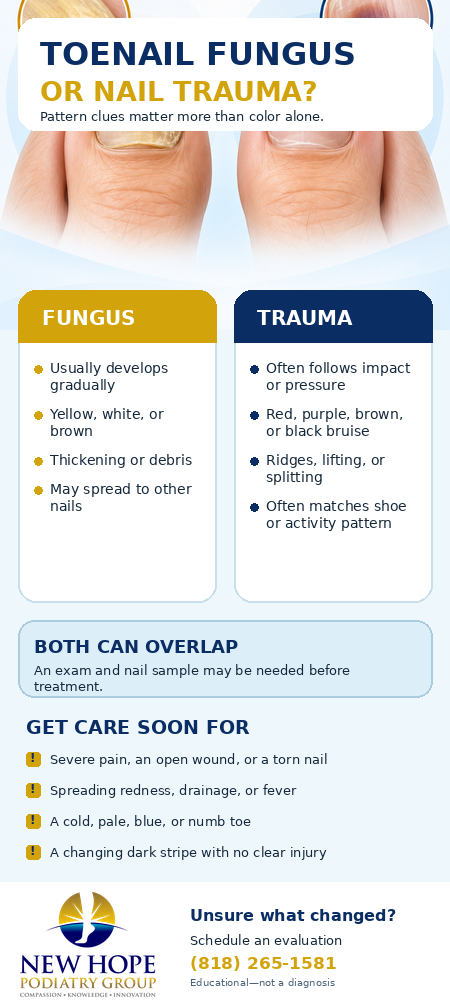
A toenail that turns yellow, becomes thicker, develops a dark spot, or starts lifting may be showing signs of fungus, repeated pressure, or a direct injury. The color alone usually cannot tell you which one is responsible. The timing, number of nails involved, shoe and activity history, pain pattern, and changes in the surrounding skin provide more useful clues. When the cause is uncertain or the nail is getting worse, a podiatry evaluation can help identify the problem before treatment begins.
Toenail fungus and nail trauma can also occur together. A damaged nail may be easier for fungi to enter, while a thick fungal nail may catch inside a shoe and become repeatedly irritated. That overlap is one reason self-treating every changed nail as fungus can lead to months of frustration without addressing the real cause.
What a Changed Toenail May Look Like
Toenails protect the sensitive tissue at the end of each toe. The visible nail plate grows from living tissue under and behind the nail, so changes may appear slowly and remain visible while new nail grows forward.
A changed nail may be:
- yellow, white, brown, greenish, red, purple, or black;
- thicker or thinner than the neighboring nails;
- brittle, crumbly, cracked, ridged, or distorted;
- separated from the nail bed;
- tender when pressed or squeezed inside a shoe; or
- surrounded by redness, swelling, drainage, or scaling skin.
None of these findings belongs exclusively to one condition. The American Podiatric Medical Association’s overview of toenail fungus describes discoloration, debris beneath the nail, thickening, and progressive nail changes. Pressure from running shoes, work boots, hiking, or a single impact can create some of the same changes.
Toenail Fungus vs Nail Trauma: Pattern Clues
The following differences can help organize what you have noticed, but they are not a substitute for an examination.
|
Clue |
Fungal nail infection may be more likely |
Nail trauma may be more likely |
|
Onset |
Gradual change without one memorable event |
Change after a stub, dropped object, long walk, run, or tight shoe |
|
Number of nails |
May begin in one nail and spread to others over time |
Often limited to the nail or nails exposed to pressure |
|
Color |
Yellow, white, or brown discoloration is common |
Red, purple, dark brown, or black may reflect blood under the nail; yellowing can occur as a damaged nail lifts |
|
Texture |
Thickening, crumbling, debris, and distortion may progress |
Splitting, ridges, lifting, or a bruise may follow the injury pattern |
|
Surrounding skin |
Athlete’s foot, scaling, or itching may be present |
Blistering, tenderness, or a pressure point may match the shoe or event |
|
Course |
Persists and slowly advances without effective treatment |
The discolored area may move toward the tip as the nail grows, although repeated pressure can keep causing new damage |
Clues that fit toenail fungus
Toenail fungus, also called onychomycosis, often develops gradually. A nail may lose its usual clarity, become yellow or white, thicken, and collect crumbly material beneath the edge. It may become harder to trim or uncomfortable when shoes press on it. Some people also have peeling or itchy skin between the toes or along the sole, although a fungal nail can occur without obvious athlete’s foot.
Fungi tend to thrive in warm, damp environments. The chance of infection may be higher when feet stay sweaty in enclosed shoes, when communal wet areas are used barefoot, or when a nail has already been damaged. Age, diabetes, reduced circulation, and immune-system conditions can also affect risk and the consequences of leaving a problem unchecked.
Fungal changes are often slow. That makes it difficult to remember exactly when they began, and treatment progress may also be slow because clearer nail has to grow from the base rather than appearing across the whole nail at once.
Clues that fit nail trauma
Trauma may be sudden, such as dropping something on the toe or striking it against furniture. It may also be repetitive and less memorable. A toe that repeatedly hits the front of a running shoe can develop bruising, nail thickening, ridges, lifting, or a loose nail even when no single step felt like an injury.
Blood trapped beneath the nail can create a red, purple, dark brown, or black area called a subungual hematoma. The toe may throb soon after a significant impact because pressure builds under the nail. With a mild injury, the dark area often becomes less tender and travels toward the tip as the nail grows. A badly damaged nail can loosen or eventually shed.
Repeated pressure changes the pattern. If the shoe remains too short, narrow, or loose enough for the foot to slide, the nail may be injured again before it finishes growing out. The discoloration may then seem fixed even though new trauma is occurring.
Other Causes Can Resemble Both
Not every thick or discolored toenail is fungal or traumatic. Psoriasis and other inflammatory skin conditions can produce pitting, thickening, lifting, or debris. Bacterial growth can sometimes create greenish discoloration beneath a separated nail. Medication effects, aging, circulation problems, and growths involving the nail unit can also change its appearance.
A dark spot deserves attention when there was no clear injury, it widens or changes, it does not move outward with nail growth, or pigment extends onto the skin beside the nail or near the cuticle. Most dark nails are not cancer, but an unusual or evolving pigment pattern should be examined rather than covered with polish indefinitely.
This broader list matters because antifungal medication will not correct a pressure injury, inflammatory nail disorder, or another nonfungal cause. Conversely, waiting for a presumed bruise to grow out may delay care if the pattern is not behaving like an injury.
Why Appearance Alone May Not Settle the Diagnosis
A clinician starts with the history. Useful details include when the change began, whether there was an impact or recent change in footwear, which activities create pressure, whether more nails are changing, and whether the skin is itchy or scaly. Diabetes, circulation, sensation, immune status, medications, and prior nail treatment also influence the evaluation.
The examination may assess the nail’s color and thickness, attachment to the nail bed, debris, tenderness, and the skin around and between the toes. Shoe fit and the way pressure reaches the front of the foot may matter when repetitive trauma is suspected.
When fungus remains a possibility and the result would change treatment, a nail clipping or scraping may be examined. Methods can include microscopy, staining of a nail clipping, culture, or molecular testing. A clinical review available through the National Institutes of Health explains why confirmatory testing is useful before antifungal therapy: several nail disorders can look fungal, and treatment choices have different risks and practical demands.
Not every changed nail needs every test. The selection depends on the pattern, severity, previous treatment, health history, and whether identifying a specific organism would affect the plan.
Treatment Depends on the Cause
The goal is not simply to make the nail look different. Treatment should address the process changing the nail and reduce pain or functional problems.
When a fungal infection is confirmed
Options may include topical or oral antifungal medication, thinning or trimming a thick nail, and measures that reduce moisture and reinfection. The best option depends on how much of the nail is involved, how many nails are affected, the health of the nail-growth area, other medical conditions, and possible medication interactions.
Topical medicine must reach the involved area and is generally used over a prolonged period. Oral medication may be considered for some people but is not appropriate for everyone. A clinician may review current medications and health factors and decide whether laboratory monitoring is appropriate. There is no one-size-fits-all plan, and a nail that looks clearer still needs time to grow forward.
Care of shoes, socks, and trimming tools may be part of preventing recurrence. Treating fungal skin infection at the same time can also matter because organisms on the surrounding skin may affect the nail again.
When trauma is responsible
Minor pressure-related changes may improve by correcting shoe fit, protecting the toe, reducing the activity that repeatedly strikes the nail, and allowing the damaged portion to grow out. The right shoe should give the toes room without letting the foot slide forward. Thick socks do not compensate for a shoe that is too short.
A painful pool of blood after a recent impact, a nail that is torn, or concern for a fracture needs professional assessment. Do not puncture the nail at home. Drainage is a clinical procedure used only in appropriate cases, and a toe injury may need imaging or wound care depending on the mechanism and examination.
If the nail detaches, the skin beneath it needs protection while the new nail grows. Avoid pulling off attached portions. A podiatrist can trim an unstable edge safely and check for a laceration, infection, or pressure source.
What You Can Do While Waiting for an Evaluation
Keep the foot clean and dry, change damp socks, and use shoes with enough depth and length for the toes. Trim nails straight across when the nail can be cut comfortably, and smooth sharp edges instead of digging into the corners. Use clean clippers and do not share them.
Take a clear photograph in consistent lighting every few weeks. A dated photo can show whether a dark area is moving outward with nail growth or whether thickening is spreading. Remove polish before an appointment when possible so the nail and surrounding skin can be examined.
Avoid scraping deeply beneath the nail, tearing off loose sections, or using household bleach, peroxide, or other caustic substances. These steps can injure the skin without confirming or resolving the cause. If you have diabetes, reduced circulation, numbness, or a weakened immune system, ask for professional guidance before attempting nail care or over-the-counter treatment.
When a Changed Nail Needs Prompt Attention
Arrange an evaluation when a nail change persists, spreads to additional nails, becomes painful in shoes, repeatedly returns, or does not follow the expected pattern after an injury. It is also reasonable to seek care before starting months of antifungal treatment when the diagnosis is uncertain.
Seek more urgent medical attention for severe pain after a crush injury, an open wound, uncontrolled bleeding, a nail that is largely torn away, major swelling or deformity, rapidly spreading redness, pus, fever, red streaking, or a toe that becomes cold, pale, blue, or numb. A dark stripe or patch that changes, widens, or extends onto nearby skin should be examined promptly, especially when there is no clear injury.
People with diabetes, neuropathy, poor circulation, immune suppression, or a history of foot ulcers should use a lower threshold for professional evaluation. Reduced sensation can hide pain, and a small skin break can be easier to miss.
How New Hope Podiatry Can Help
New Hope Podiatry Group of Glendale’s conditions page includes toenail fungus and other nail, skin, nerve, and foot concerns. An evaluation can focus on whether the nail pattern fits infection, pressure, an injury, or another condition and whether testing would change the treatment plan.
If a changed toenail is persistent, painful, or difficult to identify, schedule an appointment with New Hope Podiatry Group of Glendale. Call the Glendale office at (818) 265-1581 or visit the appointment page to learn how to request a visit.
Frequently Asked Questions
1. Can a bruised toenail turn yellow?
Yes. A nail may look yellow as it lifts from the nail bed or as an older injury grows out. Yellow color is also common with fungal infection, so the timing, pattern, and other nail changes matter more than color by itself.
2. Does toenail fungus always spread to other nails?
No. It may stay limited to one nail, especially early on, although it can involve additional nails or nearby skin over time. A one-nail pattern does not prove trauma, and a multi-nail pattern does not prove fungus.
3. Will a dark toenail fall off after an injury?
It might. A nail that was significantly damaged may loosen as a new nail forms underneath, but many bruised nails remain attached and the dark area simply moves forward with growth. Do not pull off a nail that is still attached.
4. Can tight shoes cause thick toenails?
Repeated contact with the front or top of a shoe can injure the nail-growth area and lead to thickening, ridges, lifting, or discoloration. Shoe pressure can also aggravate a nail that is already thick because of fungus or another condition.
5. How can a podiatrist test for toenail fungus?
A podiatrist may collect a clipping or material from beneath the nail. Depending on the situation, the sample can be examined with microscopy, special staining, culture, molecular testing, or a combination. Testing is selected when the result is likely to affect treatment.
6. Can I treat a changed toenail with an over-the-counter antifungal first?
Some nonprescription products are intended for fungal skin or nail concerns, but a changed nail may not be fungal and nail infections can be difficult to reach. If the diagnosis is unclear, the nail is painful or extensive, or you have medical risk factors, an evaluation before prolonged treatment is a safer next step.
7. How long does it take for a normal-looking toenail to grow back?
Toenails grow slowly, and the visible recovery depends on which part of the nail was damaged and whether the cause has stopped. Clearer nail usually appears from the base and advances toward the tip over many months. A clinician can give more specific expectations after examining the nail.
8. When should a person with diabetes call about a toenail change?
People with diabetes should contact a qualified healthcare professional promptly for a nail change accompanied by a cut, drainage, redness, warmth, swelling, odor, color change in the toe, or uncertainty about safe trimming. Neuropathy or poor circulation can reduce warning symptoms, so waiting for pain is not a reliable strategy.
Disclaimer
This article provides general educational information and does not replace an evaluation, diagnosis, or treatment plan from a qualified healthcare professional.