

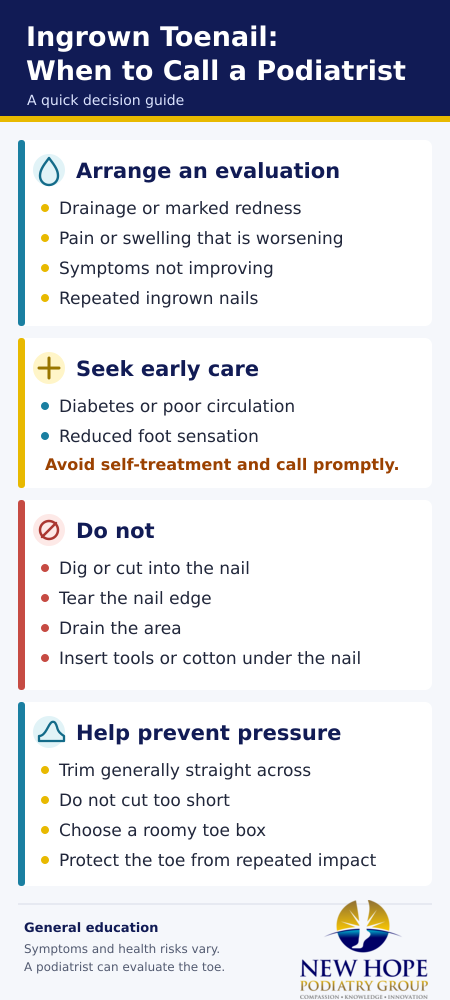
 An ingrown toenail can start as tenderness where the nail meets the skin. The next step depends on what happens from there. Mild, early irritation in an otherwise low-risk person may settle when pressure and repeated trauma are reduced. Increasing pain, redness, swelling, drainage, trouble wearing shoes, repeated episodes, or certain health conditions are reasons to stop relying on home care and arrange an evaluation.
An online article cannot tell whether a toe is infected or identify the right treatment for a particular person. It can, however, help you recognize when to see a podiatrist for an ingrown toenail, understand what a visit may involve, and avoid home treatment that could make the area worse. The goal is a calm, practical decision: watch a mild problem carefully only when it is reasonable to do so, and seek professional care when the symptoms or your health history lower that threshold.
What an Ingrown Toenail Is and Why Symptoms Can Progress
The nail edge and surrounding skin
An ingrown toenail develops when the side or corner of a nail presses or curves into the neighboring skin. It most often affects a big toe, although another toe can be involved. The contact between the nail and skin may cause localized tenderness, irritation, redness, or swelling. If the nail continues to press into the tissue, the irritation may become more pronounced.
Common contributors
Several factors can contribute. Cutting a nail too short or rounding deeply into the corners can encourage the surrounding skin to meet the nail edge. Shoes with a narrow or short toe box may crowd the toes. A stubbed toe, an object dropped on the foot, running, kicking, or another source of repeated pressure can also irritate the area. Some people have a naturally curved nail shape, and changes associated with nail disease or previous injury may play a role.
These are possibilities, not a way to determine the cause of your symptoms at home. A podiatrist can look at the nail, the skin around it, and the factors that may be keeping the problem active.
How symptoms may change
Early irritation may feel tender when the toe is pressed or placed in a shoe. Increasing redness, swelling, warmth, drainage, odor, or prominent tissue beside the nail can indicate that the problem is progressing. No single appearance proves infection from a photograph or description. A break in the skin can allow bacteria to enter, so worsening changes deserve an in-person assessment rather than repeated experimentation at home.
New Hope Podiatry Group of Glendale includes ingrown toenails among the conditions treated by our Glendale podiatrists. This article focuses on the decision to seek care rather than replacing that evaluation.
When Should You See a Podiatrist for an Ingrown Toenail?
Pain, redness, or swelling is getting worse
Arrange an evaluation when discomfort is increasing instead of settling, the red or swollen area is expanding, or the toe has become difficult to protect from everyday pressure. Pain that changes how you walk, keeps you from wearing your usual shoes, or limits work or activity is also a practical reason to be seen. You do not need to wait until the problem is severe before asking for help.
Recurring symptoms deserve attention even when each episode seems manageable. Repeated irritation may reflect ongoing nail shape, trimming, footwear, or activity factors. An examination can help clarify which factors are relevant and whether a different approach should be considered.
Drainage or excessive redness is present
The APMA guidance on ingrown toenails advises seeing a podiatrist promptly when drainage or excessive redness is present. These findings do not allow a reader to diagnose an infection, but they are clear reasons to stop unsupervised treatment and seek professional evaluation. Odor, increasing warmth, or prominent tissue beside the nail also adds to the reason for an assessment.
Symptoms are not improving
If a short, cautious trial of noninvasive care does not lead to improvement, arrange a visit. There is no universal number of days that is safe for every person because the appearance of the toe, severity of symptoms, health history, circulation, and sensation all matter. Seek care sooner if symptoms are worsening, drainage appears, redness becomes marked, or normal footwear and walking are affected.
You have diabetes, poor circulation, or reduced sensation
People with diabetes or poor circulation should seek podiatric care promptly at the first signs of an ingrown toenail and avoid self-treatment. Reduced sensation in the foot also lowers the threshold for care because pressure, skin damage, and worsening irritation may be harder to notice. Pain alone is not a reliable measure of severity when sensation is reduced.
These risk factors do not predict what will happen to any one person. They do mean that early professional assessment is safer than cutting, lifting, probing, or otherwise treating the nail at home.
Safe Self-Care Boundaries and What Not to Do
Self-care is a narrow option for mild, early irritation in a person who does not have drainage, excessive redness, suspected infection, diabetes, poor circulation, or reduced foot sensation. If those limits are met, reduce pressure on the toe. Choose footwear that does not crowd the front of the foot, and protect the toe from repeated impact or rubbing. Some authoritative sources discuss soaking the foot, but an appropriate method may depend on the person and the condition of the skin; this article does not prescribe a formula, temperature, or schedule.
Watch the direction of symptoms rather than repeatedly testing the toe. Stop home care and arrange an evaluation if pain, redness, or swelling increases; drainage or marked redness appears; walking or footwear becomes difficult; or a short trial does not help. Recurrent symptoms are another reason to move beyond self-care.
Do not dig or cut deeply into the nail border, tear away the nail edge, drain the area, or place tools or cotton beneath the nail. Do not try to remove nail tissue in the bathroom. These actions can injure the skin and may create more opportunity for bacteria to enter. Over-the-counter medication should not be used to mask a worsening problem or as a substitute for evaluation. Medication decisions belong with a clinician who has examined the toe and considered your health history.
Risk Factors That Lower the Threshold for Evaluation
- Diabetes, circulation, and sensation
Diabetes can be associated with reduced sensation and circulation problems in the feet. Reduced sensation may make an injury or pressure point less noticeable, while poor circulation can interfere with healing. The same caution applies to a person with known poor circulation or nerve damage in the foot, even if pain seems minor. Prompt care allows a clinician to assess the nail and skin before a small problem becomes harder to manage. - Repeated pressure and trauma
Running, kicking sports, long periods in restrictive footwear, or work shoes that crowd the toes may create repeated pressure at a nail border. A single injury, such as stubbing the toe or dropping something on it, can also contribute. If the activity or footwear cannot be modified without disrupting daily life, an evaluation may help identify practical ways to reduce irritation. - Nail shape, prior episodes, and nail changes
A naturally curved nail, previous ingrown toenails, or changes in a thickened or damaged nail may increase the chance that symptoms return. The appearance alone does not establish why a nail is growing that way. When episodes recur, a podiatrist can evaluate the pattern rather than treating each flare as an isolated problem.
What a Podiatry Evaluation May Include
A focused history
The visit usually begins with questions about when the symptoms started, whether the problem has happened before, and how it has changed. The podiatrist may ask about recent trauma, footwear, running or other repetitive activity, and any care you have already tried. Diabetes, known circulation problems, and reduced sensation are important to mention because they may affect the assessment and plan.
Examination of the nail and toe
The clinician may examine the nail border and surrounding skin for tenderness, swelling, drainage, tissue changes, and the extent of irritation. Circulation and sensation may also be assessed when they are relevant. The purpose is to determine whether the nail is pressing into the skin, look for signs that may be consistent with infection, and consider whether another nail or skin problem could be contributing.
Many ingrown toenails are evaluated clinically, meaning the history and physical examination provide the information needed for the next decision. Tests, cultures, laboratory work, or imaging are not automatic. A clinician may consider additional testing only when the findings or another suspected problem make it useful.
A plan based on the findings
The evaluation does not commit you to a procedure. It creates a basis for discussing the severity of the problem, how often it has returned, relevant health risks, and the advantages and limitations of reasonable options. At New Hope Podiatry, we use the visit to evaluate your foot concern and discuss next steps suited to the findings. Readers who want broader practice context can review our podiatry services in Glendale.
Treatment Categories Depend on Severity and Recurrence
For selected mild cases, a clinician may discuss reducing pressure, changing nail-care habits, monitoring the area, or other nonprocedural measures. The appropriate advice depends on the condition of the skin, the position of the nail edge, prior episodes, and individual health risks.
Medication is not automatic. A clinician may consider medication when examination findings support it, but an article cannot determine whether it is needed or which medication would be appropriate. Do not use leftover prescriptions or another person’s treatment plan.
For a persistent, recurrent, or more advanced ingrown nail, a clinician may discuss a procedure that removes the offending nail edge. In some circumstances, treatment of the nail-producing tissue may also be considered to reduce regrowth at that border. This is a category of care, not a statement that a particular technique will be recommended or is available at the Glendale office.
A 2023 NIH-indexed systematic review of ingrown-toenail procedures found important limitations in the quality and consistency of comparative evidence. Definitions of recurrence varied, and certainty was low or very low for many comparisons. That is one reason to avoid blanket claims about a best procedure, permanent correction, recovery time, or expected result. The choice should follow an examination and an individualized discussion of benefits, limitations, and risks.
Why Ingrown Toenails Recur
An ingrown toenail may return when the underlying relationship between the nail edge and surrounding skin remains unchanged. A curved nail shape, continued pressure from shoes or activity, repeated toe trauma, cutting patterns, or another nail condition may contribute. More than one factor can be present, and temporary improvement does not show which one matters most.
Recurrence changes the decision because repeated cutting or digging can create a cycle of short-lived relief followed by renewed irritation. Even if each episode appears mild, a podiatry evaluation can assess the pattern and explain options based on the nail, the skin, health risks, and prior response. No approach can promise that an ingrown toenail will never return.
Prevention After Symptoms Settle
Prevention begins with reducing avoidable pressure and nail trauma. Trim toenails generally straight across and avoid cutting them too short. Do not dig into the corners or rip and tear uneven nail edges. These habits are intended for routine nail care after irritation has settled, not as instructions to cut into a nail that is already ingrown.
Choose shoes with enough length and toe-box room so the toes are not crowded. The right shape matters as much as the stated size. Pay attention to repeated impact during work, running, or kicking sports, and protect the toe where practical. If one pair of shoes consistently triggers tenderness at the nail border, stop using it until the fit can be addressed.
People with recurring ingrown toenails or higher-risk health conditions should ask a podiatrist for individualized nail-care advice instead of repeating self-treatment. Prevention cannot change every inherited nail shape or eliminate every injury, but it can reduce avoidable pressure and trauma.
Frequently Asked Questions
1. Can an ingrown toenail go away on its own?
Mild, early irritation may improve when pressure and repeated trauma are reduced, but an article cannot determine the severity of a particular toe. Increasing pain, redness, swelling, drainage, difficulty with shoes, recurrence, or failure to improve after a short trial changes the next step. People with diabetes, poor circulation, or reduced foot sensation should avoid self-treatment and seek professional care promptly.
2. What signs may suggest an ingrown toenail needs prompt evaluation?
Increasing pain, excessive redness, swelling, drainage, odor, warmth, prominent tissue beside the nail, and difficulty walking or wearing shoes are reasons to arrange an assessment. A symptom can have more than one explanation, so these signs should not be used to diagnose an infection at home. Worsening or repeated symptoms also warrant evaluation, even without drainage.
3. How long should I try home care before seeing a podiatrist?
There is no universal day count. APMA recommends seeing a podiatrist when a short trial of home treatment does not improve the condition. Seek care sooner if symptoms worsen, drainage or marked redness appears, walking becomes difficult, or the problem returns. Diabetes, poor circulation, or reduced sensation are reasons to avoid self-treatment and call promptly.
4. Should someone with diabetes treat an ingrown toenail at home?
No. APMA advises people with diabetes or poor circulation to avoid self-treatment and seek podiatric care promptly at the first signs of an ingrown toenail. Diabetes may be associated with reduced sensation or circulation problems, so pain may not reflect the seriousness of a foot problem. Do not cut, probe, or place material beneath the nail.
5. What happens during a podiatry visit for an ingrown toenail?
The podiatrist may ask when symptoms began, whether they recur, what pressure or trauma may be involved, and what care you have tried. The examination may assess the nail border, surrounding skin, tenderness, swelling, drainage, circulation, and sensation as relevant. Options are then discussed based on the findings; testing and treatment are not identical for every patient.
6. Does seeing a podiatrist mean the toenail will be removed?
No. A visit begins with an evaluation, not an automatic procedure. The plan depends on the position of the nail, condition of the surrounding skin, symptom severity, recurrence, health factors, and response to prior care. A clinician may discuss nonprocedural measures or removal of an offending nail edge, but no single option is right for everyone.
7. Why does my ingrown toenail keep coming back?
Recurrence may relate to a curved nail shape, repeated shoe or activity pressure, toe trauma, trimming patterns, or another nail problem. More than one contributor may be involved, and the cause cannot be assigned reliably from symptoms alone. A podiatrist can examine the recurring pattern and discuss appropriate options without promising that recurrence can be eliminated.
8. How can I reduce the chance of another ingrown toenail?
Trim nails generally straight across, do not cut them too short, and avoid digging into corners or tearing nail edges. Choose shoes with enough room for the toes, and reduce repeated impact or pressure when practical. If the problem keeps returning, or if you have diabetes, poor circulation, or reduced sensation, ask a podiatrist for individualized guidance.
Schedule an Evaluation in Glendale
If an ingrown toenail is worsening, draining, repeatedly returning, or interfering with shoes or walking, an examination can help clarify the next step. At New Hope Podiatry Group of Glendale, we can evaluate the nail, surrounding skin, and relevant foot-health risks, then discuss options based on the findings.
Schedule an appointment with New Hope Podiatry Group of Glendale for an evaluation of your foot or ankle concerns. Call our Glendale office at (818) 265-1581, or visit the appointment page to learn how to request a visit.